The quiet migration: Why so many teams are moving from ChatGPT to Claude
 Jovana Lazarevska

A year ago, “which AI tool do you use” had one obvious answer. That’s no longer true, and the shift has happened faster than most people expected.
What actually happened
Start with the numbers, because they tell a clearer story than any opinion piece can. In April 2026, Anthropic’s Claude overtook OpenAI on Ramp’s AI Index, a widely-cited measure of business adoption, with 34.4% of enterprise usage on the platform against OpenAI’s 32.3%. Ramp also found Anthropic winning around 70% of head-to-head matchups among first-time enterprise buyers choosing an AI provider. Separately, Sensor Tower’s State of AI report found Claude now earns more revenue per user than ChatGPT ($2.76 versus $1.74), even though it has far fewer total users, and converts a higher share of them to paid plans (13% versus 8%).
The gap looks widest in coding, where developer surveys and industry reporting consistently put Claude ahead on enterprise adoption, though exact market-share figures vary by source and are worth treating as directional rather than precise.
None of this means ChatGPT is struggling. It crossed 1 billion monthly active users this year, the fastest app ever to do so, and remains the market leader by user count in almost every country. The two products have increasingly stopped competing for the same customer. ChatGPT dominates the consumer, everyday-assistant market. Claude has pulled ahead with businesses, developers and anyone doing high-stakes, detailed work.
Why people actually switched
Three reasons keep coming up.
The first is trust, in a fairly literal sense. When OpenAI signed a deal to supply the Pentagon, not long after Anthropic had reportedly been ruled out of similar work, it triggered a visible wave of ChatGPT app uninstalls, and Claude was the biggest beneficiary. For regulated industries in particular, that kind of predictability matters more than a flashy demo.
The second is how each tool actually works on real tasks. Claude Code doesn’t just autocomplete lines, it takes a brief, plans the work, and executes across a whole project, checking in as it goes. Developers consistently point to it as better at holding a large codebase in its head and reasoning through a multi-file change, rather than treating each file as its own puzzle.
The third is simpler: the writing itself. Claude’s output reads as more considered and less templated. For content, strategy work and anything client-facing, that difference compounds. Teams that switched often say the same thing, that they spent less time rewriting what the AI gave them.
Is it actually “better”?
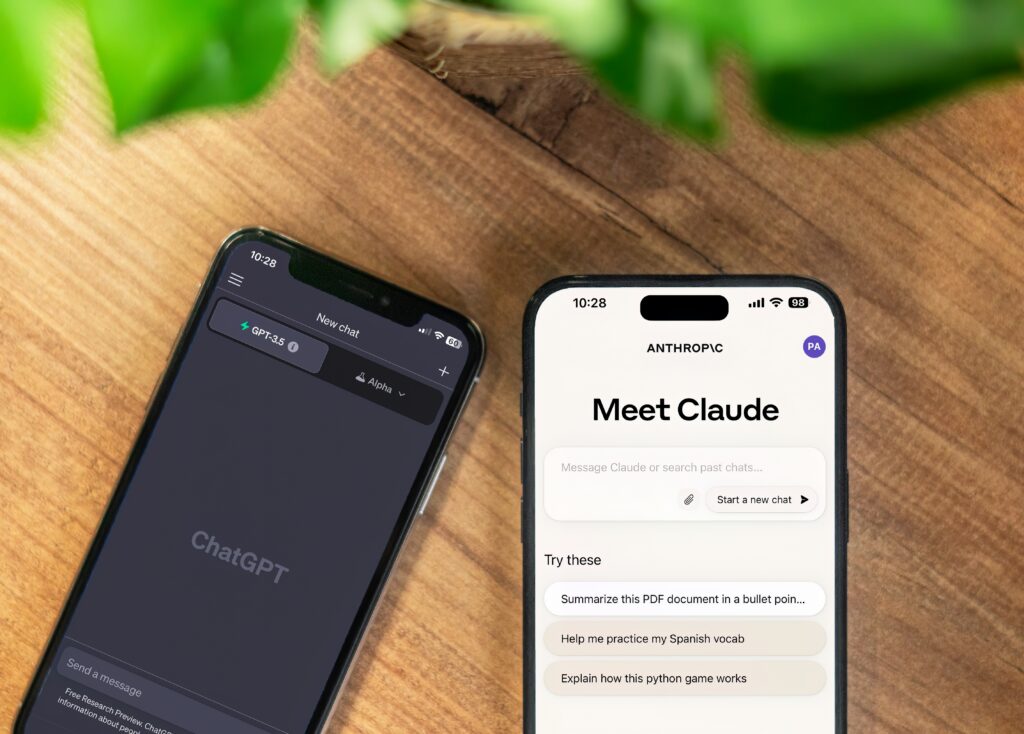
Better is doing a lot of work in that sentence, and the honest answer is: better for some things.
If you want a fast, general-purpose assistant for quick everyday questions, ChatGPT is still an excellent, deeply embedded tool, and its scale is not something a business decision should ignore. If your work involves regulated data, complex codebases, long documents, or content that needs to sound genuinely considered rather than generated, the evidence increasingly points to Claude.
The more useful question for most businesses isn’t “which one wins”, it’s “which one fits the job in front of us”. The market itself seems to have reached the same conclusion, which is exactly why the two companies aren’t chasing the same customer anymore.
The takeaway for Jersey businesses
Watching this play out over the last few months, the lesson isn’t “switch tools”. It’s that the AI landscape is moving fast enough that the tool you settled on a year ago may no longer be the right default. Worth revisiting every few months, not setting once and forgetting.