How to use AI for marketing content without sounding like a robot
 Jovana Lazarevska

Brief your AI like a copywriter, and it will sound like you every time.
Most of us are already using AI to help create marketing content. Drafting a LinkedIn post, writing up a service page, putting together a press release, or knocking out a newsletter, AI has quietly become part of the workflow for a huge number of businesses.
And that is completely fine. The efficiency gains are real, and ignoring them at this point would put you at a genuine disadvantage.
But here is the thing. There is a version of AI-assisted marketing that works brilliantly for your brand, and there is a version that slowly undermines it. Most businesses right now are closer to the second version than the first, and the gap usually comes down to one thing they have never thought to do.
The problem with most AI marketing content

Spend sixty seconds scrolling LinkedIn and you will spot it. The overly structured paragraphs. The sentences that follow the same rhythm. The phrases that sound polished but somehow say very little. AI-written content has a very distinctive texture, and your audience picks up on it even if they cannot put their finger on exactly what feels off.
It is not just a LinkedIn problem. Whole websites are being filled with AI-generated pages and articles, and the consequences are becoming more visible. Google has been handing out significant ranking penalties to sites that lean too heavily on this kind of content. The Shopify blog is one of the more talked-about recent examples, taking a real hit from an algorithm update after publishing too much AI-generated material at scale.
For Jersey businesses using AI to stay on top of their marketing, this is worth paying attention to. The risk is not that you use AI. The risk is that you use it without thinking carefully about what you are actually putting out.
Why generic content happens
The most common way people use AI for marketing looks something like this. Open ChatGPT. Type a prompt along the lines of “write a LinkedIn post about our accountancy services.” Paste whatever comes back. Publish.
There is no real thought given to whether the AI knows anything about the business, the services, the tone, or the audience. And so the output reads like it could have come from any business, in any industry, anywhere in the world. Because it could have.
The AI is not doing anything wrong. It is doing exactly what you asked. The problem is that you asked it to write without giving it anything to write from.
Think about how you would bring in a freelance copywriter. You would not just say “write us something” and leave them to figure out the rest. You would give them your brand guidelines, your tone of voice, some examples of past content that worked, a proper brief on who the audience is and what they care about. A good copywriter needs to understand your business before they can write for it convincingly.
AI works in exactly the same way. The output is only ever as good as the context you put in. Generic input produces generic output, every single time. The businesses producing AI content that still feels like them, that has personality and specificity and is genuinely useful to their audience, are not just better at writing prompts. They have taken the time to set things up properly before they generate anything at all.
What a proper AI content setup actually looks like
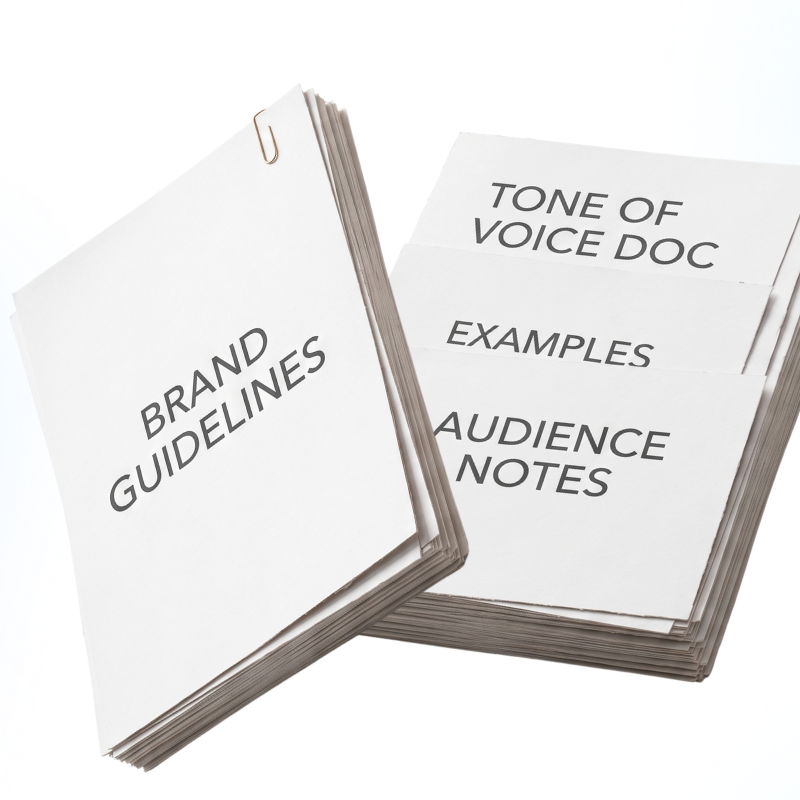
The good news is that this is far simpler than it sounds. You do not need a complicated system or a technical background. You just need a small set of files that sit alongside whatever AI tool you use, whether that is Claude, ChatGPT, Copilot, or something else entirely.
These files give the AI what it needs to write in your voice, about your business, for your audience. They do not need to be long or beautifully formatted. They just need to exist, and they need to be accurate. Here is what makes a real difference:
A tone of voice document. This captures the phrases you naturally use and, just as importantly, the ones you would never use. How do you talk to clients? What is the register you aim for? Formal or conversational? Technical or plain English? Write it down.
A service overview written the way you would describe it on a call. Not the polished marketing version. The version where someone asks what you do and you just explain it. That natural language is far more useful to the AI than a formal description lifted from your website.
Three or four examples of past content that landed well. Posts, articles, emails, anything that went down well with your audience and felt right. These give the AI a feel for what good looks like in your world.
A brief on your audience. Who are they? What do they care about? What problems are they trying to solve? Even a short paragraph makes a meaningful difference to what the AI produces.
A brand dos and don’ts list. The things you always do, and the things you would never do. Keep it practical and honest.
That is genuinely it. Once those files are loaded into a Claude Project, a ChatGPT Project, or a folder your tool can reference, the output changes noticeably. It stops being generic. It starts sounding like it came from your business rather than from a template. You find yourself editing rather than rewriting. The time saved adds up quickly, and the content is actually worth publishing.
AI as a writing partner, not a shortcut
It is worth being clear about what this approach does and does not do.
It does not replace your thinking. Your ideas, your perspective, your point of view — those still have to come from you. What the system does is take what you want to say and write it in your voice, for the people you are trying to reach. You bring the substance and the idea. The AI brings the structure and the polish.
You are not asking it to come up with what you want to say. You are handing it your thinking and saying: write that the way I would write it, for the audience I am trying to reach. With your brand voice, your tone and your service knowledge already loaded in the background, it produces content that sounds like you, pretty much as you would want it, with just a small tweak or two to get it over the line.
Moving from using AI as a quick shortcut to using it as a properly briefed writing partner is where the real value is. And it is available to any business willing to spend a few hours setting things up properly.
The bottom line
AI is not going away, and neither is the pressure to produce consistent, quality content across multiple channels. The businesses that will do this well are not the ones with the biggest budgets or the most sophisticated tools. They are the ones that take the time to brief the AI properly.
Set it up once with the five files above, and the content you produce will sound like you, reach your audience, and hold up to scrutiny. Skip that step, and you are just adding to the noise.
The choice is a fairly easy one.
Blue Llama helps Jersey businesses use technology in ways that actually make a difference. If you want to talk through how to set up an AI marketing system for your business, we would be happy to help.